Deme, Sofia, and what specialist AI actually means.
Specialism is built in, not configured on. Custom GPTs are specialist by configuration. Deme and Sofia are specialist by construction.
The word "specialist" has become a marketing term in AI product descriptions. Every assistant claims some version of it. The claim usually means one of two things, and those two things are different enough that using the same word for both hides the distinction that matters.
The first meaning: specialist by configuration. A general model, given a system prompt that instructs it to focus on a domain, to maintain a persona, to prioritise certain kinds of responses over others. The model is the same general model. The specialism is the instruction layer applied at runtime. Change the instruction, change the specialist. The specialism is not in the product. It is in the wrapper.
The second meaning: specialist by construction. A configuration that was designed for a specific domain from the start, where the domain's logic, standards, and context are built into the working model, not applied to a generic one at the point of use. The specialism is the product.
Deme and Sofia are specialist by construction. That is what makes them companions rather than assistants with a themed persona.
What construction means as a design discipline
Building a companion for a specific room requires understanding the room before designing the companion. The room's logic has to be legible enough to be designed against: what it contains, what happens at its edges, what kinds of questions arise within it, what kinds of knowledge the companion needs to hold, and what kinds of knowledge fall outside the room's boundary.
This is a design problem, not a prompt engineering problem. The difference is that a prompt can be changed at any time without changing the product. A design decision shapes the product and requires a product decision to change. When the companion is specialist by construction, the specialism is in the product architecture, the knowledge model, the boundaries of what the companion will and will not engage with. These are not runtime choices. They are design choices made before the first user interaction.
The consequence of this design approach is that the companion has a perspective, not just a focus. A companion told to focus on the kitchen knows to answer kitchen-related questions and to redirect other questions. A companion built for the kitchen understands the kitchen as a system: the logistics, the rhythms, the household-specific context that makes the kitchen a room rather than a topic.
Specialism built in is a design decision made before the first prompt. Specialism configured on is a persona applied after. The companion knows the difference.
The design process for Deme and Sofia required an extended period of room research before any configuration work began. Understanding the Australian garden meant understanding the specific conditions, the seasonal calendar that runs opposite to the advice most of the internet produces, the pest and disease pressures that apply in Australian conditions, the variety selections that transfer from global catalogues and the ones that do not. Understanding the kitchen meant understanding the household kitchen as a logistical system, not a recipe reference, and the specific context of the Australian household kitchen: the pantry rhythms, the dietary patterns, the scheduling pressures that determine when cooking is possible and when it is not.
The room research preceded the companion design. That is the discipline of specialist by construction.
What Deme knows
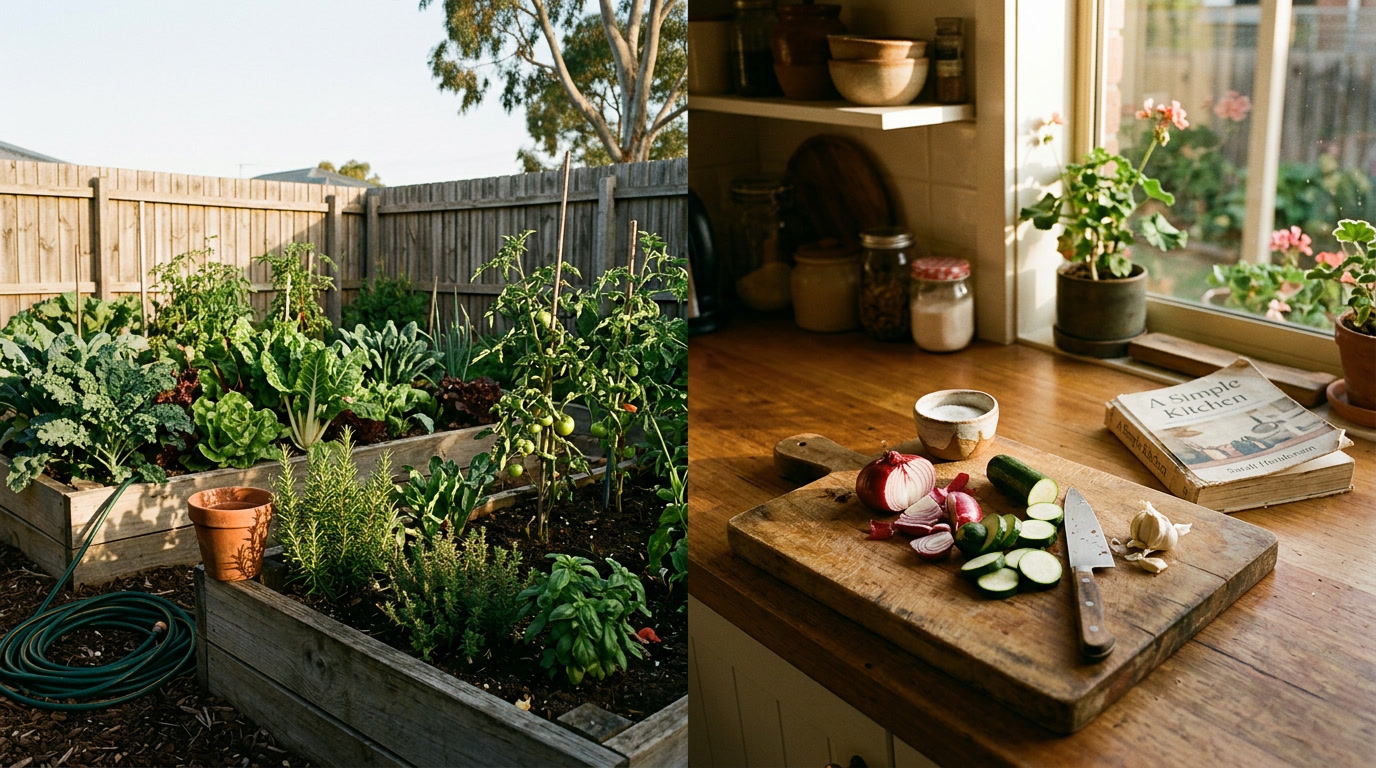
Deme's room is the Australian garden, understood as a specific context rather than a general gardening topic. The seasonal calendar runs opposite to the northern hemisphere gardening advice that dominates the internet. Summer in Perth is the dry season, not the growing season. The advice optimised for UK or US summer conditions is often counterproductive for an Australian summer. Deme knows this not because it has been told to apply a southern hemisphere correction to generic advice, but because the Australian garden is the premise.
The knowledge Deme holds includes: the specific climate zones relevant to the markets the studio operates in, and the planting, pruning, and care calendars that apply to each. The variety selections that perform well in Australian conditions and the varieties that will disappoint despite being well-reviewed in international contexts. The soil conditions that are common in Australian gardens and the amendments that address them. The pest and disease pressures that arise in Australian conditions, and the interventions that are available and appropriate here.
The spatial specificity matters. What works in a Perth backyard in February is not the same as what works in a Joburg garden in August, which is the southern hemisphere's equivalent growing month. Deme understands the geography of the room.

There is a quality that results from this kind of room-specific construction that is immediately apparent in use. A companion that knows its room can notice things the gardener has not thought to ask about. It is the time of year to start preparing the soil for the autumn planting before you have asked about the autumn planting. The aphids that appeared on the roses last week are consistent with a pattern that tends to spread if not addressed in the next week. These are not answers to questions. They are the companion navigating the room on the gardener's behalf.
Deme knows the garden. Not because it was told to focus there. Because the garden was the design premise.
The navigation quality is what distinguishes a constructed specialist from a configured one. A configured assistant can answer gardening questions well, better than a general assistant with no domain framing. It can answer what the user asks. What it cannot do is notice what the user has not asked, because it does not have a model of the room as a whole. It has answers about the room's topics.
What Sofia knows
Sofia's room is the kitchen, understood as a household context rather than a cooking instruction source. The distinction is significant. Cooking instruction sources optimise for recipes, techniques, and ingredients as abstractions. The household kitchen is a specific system: the pantry that actually exists on a Wednesday evening, the tastes that actually apply in this household, the energy level that is realistic after a long day, the dietary constraints that have to be navigated without turning every meal into a deliberation.
Sofia knows the rhythm of the household kitchen. She knows what tends to be in the pantry, what tends to run out, and what the household's actual cooking patterns look like versus what they aspire to. She knows the specific dietary constraints and preferences that apply, not as a set of rules to filter recipes against, but as context that shapes what gets surfaced before the question is asked.
The kitchen room is also a logistical room. It connects to the shopping that needs to happen, the schedule that determines when cooking is feasible, the household rhythms of who is home and when. A companion that knows the kitchen room can operate within this logistics layer, not just the recipe layer. Sofia knows when the pantry is running low on what the household actually uses, not just what an abstract well-stocked pantry should contain.
Sofia knows the kitchen. The room, not the recipe. What the household actually eats on a Tuesday, not what it claims to want.
Most AI cooking assistants optimise for the recipe layer, because the recipe layer is where the general training data is richest and where the questions are easiest to answer well. The household kitchen layer requires specific knowledge of this household, built over time, and used to inform what gets surfaced before the question is asked. That is the companion tier. It cannot be achieved by configuration.
Why one room
A natural question arises: why not build a companion that knows both the garden and the kitchen? Or the garden, the kitchen, and the household budget? Why is the room boundary a design constraint rather than a design starting point to be expanded?
The answer is about depth versus breadth. The value Deme provides is not that it knows things about Australian gardening. It is that it knows the specific garden with the depth that makes navigation possible. That depth is harder to achieve as the room expands. A companion that knows two rooms at navigation depth is harder to build than one that knows one room at navigation depth, and a companion that knows six rooms at a useful-answers depth is not a companion. It is a general assistant with a broad persona.
The room boundary is where the specialism lives. Removing the boundary does not expand the specialism. It converts it back to configuration.
Deme and Sofia are two companions, not one companion with two specialisms. Each knows one room deeply. The two rooms are related by household context, which is why they both serve the same household. But they are separate products with separate room designs, because the rooms are different enough in their knowledge requirements that building them as separate constructions produces better companions than building them as one expanded construction.
The room boundary is where the specialism lives. A companion that knows one room very well is more useful than a general assistant that can answer anything adequately.
What the user experiences
The practical difference between a companion that is specialist by construction and one that is specialist by configuration shows up in what the companion offers without being asked.
A configured assistant can answer questions about the domain it has been instructed to focus on. It can answer them well. What it cannot do is navigate: use a model of the room to decide what to surface before the question is asked. Navigation requires a model of the room as a whole, not a library of answers about room-related questions.
Deme can tell you it is time to start the preparation work for the next season's planting before you have asked about the next season. Sofia can tell you that the household has ordered the same emergency takeaway three times this week and ask if you want to do something different before you have raised the issue. These are navigational acts, not answers to questions.
The quality the studio calls "made present" is this navigational quality in action. The companion does not wait to be asked. It is present to the room in the way that a person who genuinely knows your context is present: they notice things, they say things before you ask, they are already thinking about what you are going to need before you have thought about it yourself.
This is not a technological claim. It is a design claim. It requires building the room first. Deme and Sofia were built this way. That is what specialist AI actually means.
What specialist means in the context of trust
Specialist AI and general AI produce different trust relationships. That difference is worth naming precisely, because it changes how the product is used and what users expect from it.
A general AI assistant is trusted for its breadth. The user brings a question from any domain and the assistant provides an answer. The trust is in the system's general competence. The limitation of this trust is that the user can never be confident that the answer in front of them is the result of genuine domain depth rather than the system's general ability to produce plausible-sounding output in any field. For most questions, this is acceptable. For questions where the details matter, it is not.
Deme is trusted for her depth in a single room. The user brings a question about the garden they have, in the season they are in, with the conditions specific to their location and their history. Deme's answer is trusted differently from a general assistant's answer about gardening, because Deme's answer is grounded in the specific room the construction built. The user knows the limits of that room, because the product names them. Deme knows the garden. She is not a general horticultural consultant. She is the intelligence specific to that room.
The trust that depth produces is more durable than the trust that breadth produces. A user who trusts a general assistant because it gives plausible answers has a trust that is revoked the first time an answer is wrong in a way that matters. The user does not necessarily know the answer is wrong, because the assistant is presenting it with the same confidence it presents every other answer. The trust is not calibrated to the quality of the information because there is no calibration mechanism.
A user who trusts Deme because she knows their specific garden has a trust that is calibrated to the room. When Deme says she is uncertain about something, the user knows it is a genuine signal, because Deme's confidence in the room is the product's primary commitment. The uncertainty signal is meaningful because the certainty signal is meaningful. A specialist that does not pretend to know what it does not know makes its genuine knowledge more credible, not less.
This is why the room must be designed before the product. The room's design is what makes the trust relationship possible. Without the room, the companion has no mechanism for honest uncertainty, because it has no defined scope within which to be certain.
What the distinction produces
Deme and Sofia are companions because they were built for their rooms. The specialism is in the construction. That is the distinction the word is meant to carry, and why it matters that it carries it precisely.
The companion over time
A companion's value is not static. It changes as the room changes, and as the companion's model of the room accumulates more specific context.
Deme's value in March is different from Deme's value in October, because the garden in March is at a different point in the seasonal cycle, and Deme's understanding of what happened in the months between those points has been updated by what the household observed and reported. The March Deme and the October Deme know the same room but at different points in its history.
This is different from a general assistant with memory. A general assistant with memory knows what you told it. Deme knows the room: not only what the user reported, but what the room's seasonal patterns imply about what is likely to be happening now, what decisions are likely to be coming up, and what history from the last three years is relevant to those decisions. The companion's model of the room produces anticipation. Memory produces retrieval. These are different things.
Sofia's value increases as the kitchen's patterns become clearer: the meals that consistently land well, the nights where convenience outweighs ambition, the household's actual rhythm as distinct from its stated preferences. The longer Sofia has been in the kitchen, the more the gap between "the household says it wants healthy weeknight meals" and "the household actually eats on Tuesday nights" has been modelled. That gap is where companion value lives. A new companion is guessing at the gap. A companion that has been in the room for eighteen months has closed most of it.
The design implication is that companion value is not well-served by a static product. A companion needs a mechanism for updating its model of the room: learning from what happens, updating from observations, closing the gap between the theoretical room and the actual room over time. This is one of the design investments that distinguishes companions from other AI product forms. The value is not in the initial configuration. It is in the ongoing accuracy of the room model.
Deme and Sofia are designed to improve over time. That is not a feature. It is a requirement of being a companion rather than a tool.
The companion that does not improve is a companion that has stopped listening to the room. Listening to the room is the primary job. Not answering questions about it, which is secondary. Not remembering what the user has said, which is tertiary. The primary job is maintaining an accurate, current, specific model of the room, and using that model to show up with the right thing before the user has had to ask.
A companion that gets better at that job over time is a companion worth having. A companion that remains at the same level of room understanding it had at installation is a tool with a good name. The distinction is in the design of how the model updates: whether the updates are automatic and structural, or whether they require the user to maintain the context explicitly. Users who have to maintain the context are doing the companion's job for it. That is not the product form the studio is building.
The room grows the companion. That is the right way to describe what Deme and Sofia are designed for. Not the companion grows with use, as if growth were a side effect of interaction. The room grows the companion, because the room is what the companion is made of, and more room means more specialism. Specialism is the whole argument. Deme, Sofia, and what it actually means.