We build AI people. Of course we use AI to make this site.
The imagery on this page was generated by AI, then finished by hand. The disclosure is the brand argument, not adjacent to it.

The hero image on this site was generated by AI. The first version had a texture inconsistency in the foreground: a wall that was the right colour but not the right material, something that only became visible at web resolution. We caught it on the fourth rejection pass and ran more frames before one held. The image that shipped had been through every check on the list. The one that failed partway through was discarded with the same equanimity as the one that failed at the first.
That image is on the home page now. This essay is why.
The disclosure line at the bottom of every page on this site reads: "All imagery and video on this site is AI-generated and human-edited. Same posture we bring to the products." We put that line on the page, and then we put this essay on the site, because the disclosure is not a legal obligation we are meeting at minimum. It is the argument the studio is making. The posture has to be visible. Not as a confession. As a position.
The disclosure is the brand argument. If you build AI people and hide the seam, you have already failed the product's first question.
What AI made on this site
The copy on this site was written with AI assistance. We drafted with AI across most of the editorial surfaces: the essay text, the section headings, the Companion and Co-worker page copy. The process is generation, then comparison of variants, then editing for voice. The AI-cadence sentences that survived the first generation pass were caught and cut on the edit. That process is described in its own essay on this site. What matters here is that the copy was not written by AI and released. It was written with AI and then worked.
The imagery was AI-generated. We ran many frames per shipped image, rejecting each against the editorial discipline described in its own essay on this site. Most frames fail. The failures that are hardest to catch are the most seductive: the frame that looks right at a glance but is wrong in a way that only becomes visible when you look at it the way the audience will actually see it. Those get rejected too.
The code was built with AI assistance. We use AI coding tools for component scaffolding, first-draft logic, and the boilerplate the design system already specifies. Every line is reviewed against the design before it ships. The review is the craft; the generation is the starting point.
None of this is hidden. The reason it is not hidden is that hiding it would contradict the argument the studio is making.
The standard, not the tool
Every layer of this site went through an edit pass before it shipped. The copy. The imagery. The code. Not because the generation was inadequate. Because generation produces candidates. Editorial judgment produces the result. The edit pass is where the person is put back in.
That process is described in its own essays on this site. What matters here is why it exists: the AI is part of the process. It is not the process. The person holding the standard is the process.
This extends to the products. The companion that knows your garden was not configured into existence. It was constructed: the domain knowledge was built, the vocabulary of that domain was defined, the boundaries of what the companion knows were drawn deliberately. The model is the generation layer. The construction is the selection and refinement layer. The standard the companion is held to is the product of the construction, not the model.
The site you are reading and the products described on it are built on the same operating principle. Generation is the starting point. The standard is set by the people responsible for the work.
The argument
Graaft's position in the market is a four-tier hierarchy: apps, companions, co-workers, people. Each tier describes a different relationship between an AI system and a human being.
An app automates a task. It is useful, disposable, and does not pretend to be more than it is. Most AI products in 2026 are apps. Automation has genuine value. But automation is not the thing most AI founders claim to be building.
A companion knows a room. Not a task, a room: the garden, the kitchen, the conversation register of a specific relationship. Deme knows your zone, your soil, your last three plantings, the week the tomato leaves go yellow and what to do. Sofia knows your pantry on a Sunday, the pasta the kids actually eat, the night you have already cooked twice and still need a dinner. The knowing is not a feature you configure. It is the product, by design.
A co-worker fills a role. The mine production analyst who delivers the 6am report before the morning briefing, with flagged anomalies and three-year pattern context. The project controls coordinator who has two recovery scenarios on the table before tomorrow's site meeting. The clinical reporting analyst who keeps the gap between clinical staff and compliance obligations closed. These are the roles the AU mid-market has been trying to hire for eighteen months. The co-workers fill them by construction, not by prompt.
A person is the top of the hierarchy. It is where the AI system has a continuous relationship, a name, a voice, and a presence that does not require the human to manage the system. It is the thing most AI products claim to be and almost none of them are. We are building toward it with every design decision. We are not there yet. Naming where we are is the discipline.
The studio is at step three. We build companions and co-workers. That is the honest accounting of where Graaft's products sit in the hierarchy, and it is the frame inside which all of the site's design decisions make sense.
We build AI people. Of course we use AI to make this site. The sentence answers itself.
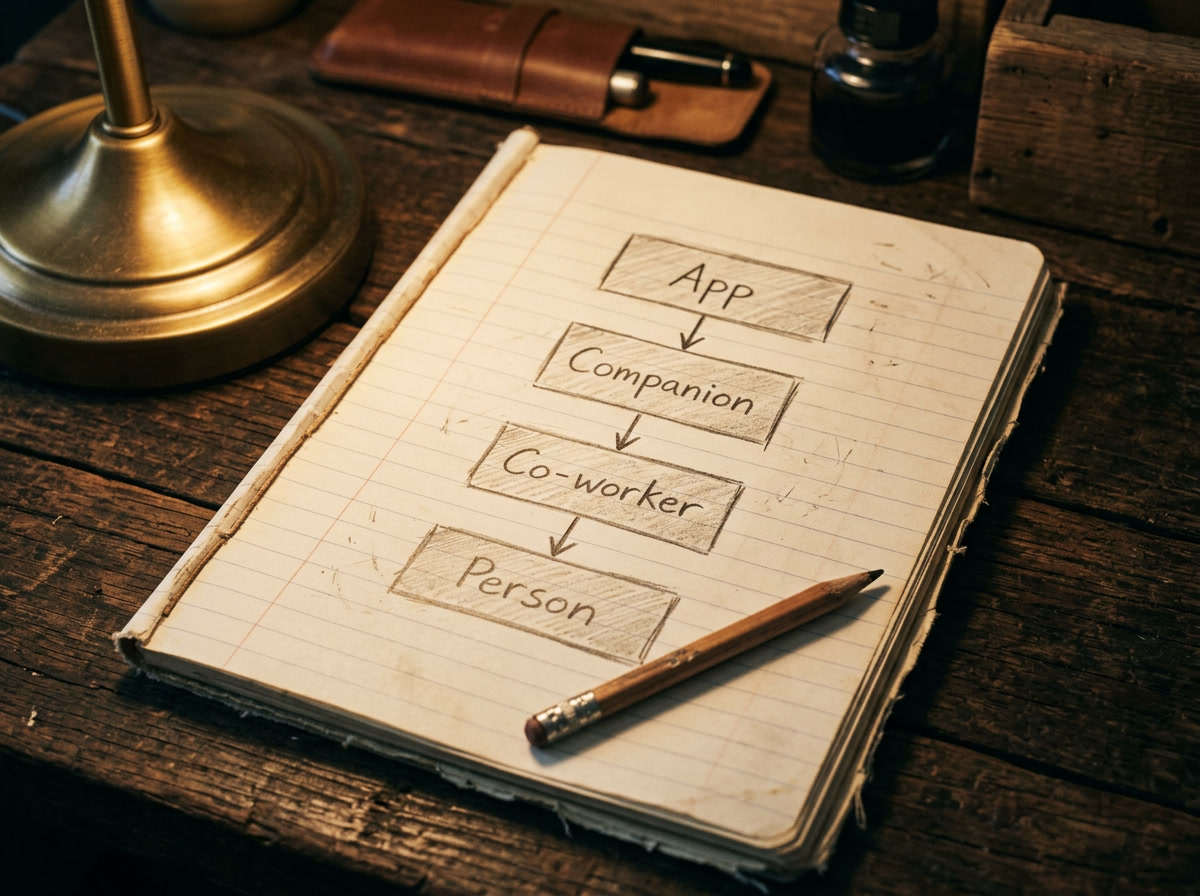
The four-line ladder in practice
The four-tier hierarchy is not a product roadmap. It is a map of what AI systems are actually doing in the world, named honestly, with the most common claim sitting at the top as the thing that almost nothing has yet achieved.
An app automates a task. The task is finite, the system is one-directional, the relationship ends when the task does. Most AI products in 2026 are apps. That is not a criticism. Automation has genuine value, and most products that describe themselves as something more are, if you look at them directly, apps with better copy.
A companion knows a room. Not just the task inside the room, the room itself: the regulars, the history, the context that turns a question like "what should I plant this month" from a search query into a personalised answer for a specific garden in a specific climate zone, by a person with a specific track record of what has and has not worked in that soil. The companion tier is where specificity becomes the product rather than a feature.
A co-worker fills a role. The distinction from a companion is that the co-worker operates in a professional context with defined accountability: it reports to operations leadership, runs on the client's data, connects to the client's systems, and is measured against outcomes. The mine production analyst who delivers the 6am anomaly report is not assisting with analysis. She is doing it, consistently, within the parameters she was constructed for.
A person has continuous presence. Not a continuous subscription to a service, a continuous relationship with a person who has a name and a voice and a memory that does not require the human to maintain the context manually. That is where the hierarchy is pointing. The studio is not there yet. Naming where we are is the discipline the hierarchy exists to enforce.
The hand-edit pass on the site's imagery is part of this discipline. A studio making the argument that AI people require presence has to demonstrate that it knows what presence costs. Many frames rejected, one shipped under a specific editorial discipline: that is the demonstration.
The companion and co-worker products are built to the same standard. Deme knows your soil type, your last three plantings, the specific week your tomatoes tend to show the first signs of stress, not because the model is powerful but because the construction work made that knowledge specific. Jordan, the project controls co-worker, has the recovery scenarios on the table before the morning site meeting, not because she can predict the future but because the domain construction built the failure patterns of civil construction projects into her operating context. The tier of the product is determined by the depth of that construction, not by the capability of the underlying model.
How the studio operates
Two humans. Sixteen AI co-workers. Will in Joburg, Dave in Perth. Six hours apart in the same time zone band, which is part of the operating model rather than incidental to it.
The sixteen colleagues are named on the About page. Tess handles research. Harper handles SaaS strategy. Cole handles marketing strategy. Lachlan holds the creative direction. Pippa writes copy. Felix leads graphic design and brand identity. Jess handles UI design. Hugh handles UX design. Maya leads frontend development. Niko handles backend development. Anika handles data and analytics. Mira leads social media strategy. Priya leads SEO and search. Joel handles email and lifecycle marketing. Tilly handles the website and CMS. Liana handles presentation design.
They are not bots. They are not automation. They are specialists who work on the studio's briefs when those specialisms are needed. Their output goes through the same kind of edit pass the site's imagery does: generation, comparison, selection, refinement, a final judgment by the founders. Every deliverable runs through both Will and Dave before it ships. The sixteen co-workers produce the specialist work; the two founders hold the standard.
This is not a claim about superior capacity. It is a description of how a small studio competes on work that would otherwise require a large agency. The AI-leveraged studio model is not new. But the version of it that names its AI colleagues, discloses its practice, and holds itself to the same standard it sets for its products is the thing Graaft is trying to be.
The disclosure is the architecture
The disclosure line at the bottom of every page is deliberate placement. Most AI disclosures in 2026 are positioned defensively: buried in terms of service, reduced to a one-word label, mentioned in passing in a press release. The defensive positioning is understandable. Disclosure invites scrutiny. Most organisations prefer to avoid both.
Graaft has made the opposite choice, and the reason is architectural. The argument the studio makes about AI products is that presence requires honesty about what the product is and what it does. The companion that does not disclose its nature is building a relationship on a misunderstanding that will eventually resolve badly. The co-worker that conceals its AI nature from the teams it works alongside is a different kind of tool from the one introduced as a named AI specialist with named specialisms. The relationship is different. The trust architecture is different. Disclosure is not a weakening of the proposition. It is a condition of it.
A studio that makes that argument and then hides its own AI usage has a consistency problem. The argument collapses on contact with its first application. The disclosure on this site is therefore not a legal minimum. It is an application of the principle the products are built on.
There is a practical consequence as well, which is separate from the consistency argument. AI-generated content that presents itself as human-generated content carries a specific vulnerability: the disclosure, when it eventually comes, retroactively undermines everything before it. The reader who discovers undisclosed AI usage does not simply revise their assessment of the disclosed content. They revise their assessment of everything the source has ever produced. That is a larger problem than the disclosure itself, and it compounds over time.
The studio has made the bet that early, accurate, specific disclosure is a better long-term position than deferred discovery. That bet is a commercial logic as well as an ethical one. The disclosure is on the page because the commercial logic holds, not only because the ethical logic requires it.
The specific form of the disclosure matters as well. "AI-generated and human-edited" is not a blanket waiver. It is a precise description of a specific process: generation, then selection, then edit, then judgment, then publication. The "human-edited" half of the disclosure is doing real work. It names the person responsible. It makes a claim about the editorial discipline applied. That claim is either accurate or it is not. The imagery editorial discipline and the AI-cadence edit discipline are what make it accurate. The disclosure is the commitment. The practice is how the commitment is kept.
What presence requires
There is a test for AI-assisted creative work that has nothing to do with how it was made. The test is presence: does the work feel like it arrived from a person, or from a process?
The process is visible in the failures. The generated image with the six-fingered hand. The copy that opens with "In today's rapidly evolving landscape." The UI that looks great in the demo because only the best-case user state was designed. The product that churns at thirty days because the worst-day scenario was never considered.
Presence is not an aesthetic quality. It is an editorial standard. The editorial rejection pass is what presence looks like at the imagery layer. The edit that removes the AI cadence sentences is what presence looks like at the copy layer. Designing the error state with the same care as the hero is what presence looks like at the product layer.
The studio has to live by the standard it builds products to. If the standard for a companion is that it knows the room specifically, the studio's own work has to be specific. If the standard for a co-worker is that they show up before you have to ask, the studio's disclosure has to be upfront, not buried. The disclosure is upfront. This essay is upfront. That is what the standard requires.
Rejections before a frame ships, until one passes every criterion. That is not a quality gate. That is what presence costs.
The site you are reading was made with AI. It was finished by hand. The standard is the same for both. The argument is that this is the only way to do it if you believe the argument you are making about AI people: that the seam between the generated and the edited is not a flaw to hide, but a practice to name. Because the practice is the product. The studio that cannot demonstrate the practice in its own work has no standing to sell it to a client. That is the argument the site is making, across every page, in every image that passed the full editorial check and every sentence that survived the edit pass. The essay you are reading is part of how it makes it.