Made present. What the second half of our brand promise actually means.
We say we build AI people. The harder word to justify is what comes after.

We say we build AI people. The second half of that statement is the harder one to justify.
Made present.
Not made useful. Not made capable. Not made available. Present. The word carries weight and I want to account for it, because it is doing more work in our brand promise than it might appear.
What presence is not
Presence is not responsiveness. A model that replies in 300 milliseconds is fast, not present. Presence is not accuracy. A model that is correct 97% of the time is reliable, not present. Presence is not personhood. Asserting that an AI system is a person in the full philosophical sense is a claim we would not make and would not find interesting to make.
Presence, in the sense we use it, is something more specific: the quality of engagement that makes an interaction feel like it was designed for this moment, for this person, in this context. Not generic capability deployed at this address. A designed response to who is here and what they need.
What presence requires
Presence requires that the co-worker or companion knows enough about the room they are in to respond to its specific demands, not its general category. A present mining co-worker responds with the knowledge of the site, the operation, the vocabulary of the team. A present kitchen companion responds with knowledge of the time of day, the prep stage, the rhythm of the cook.
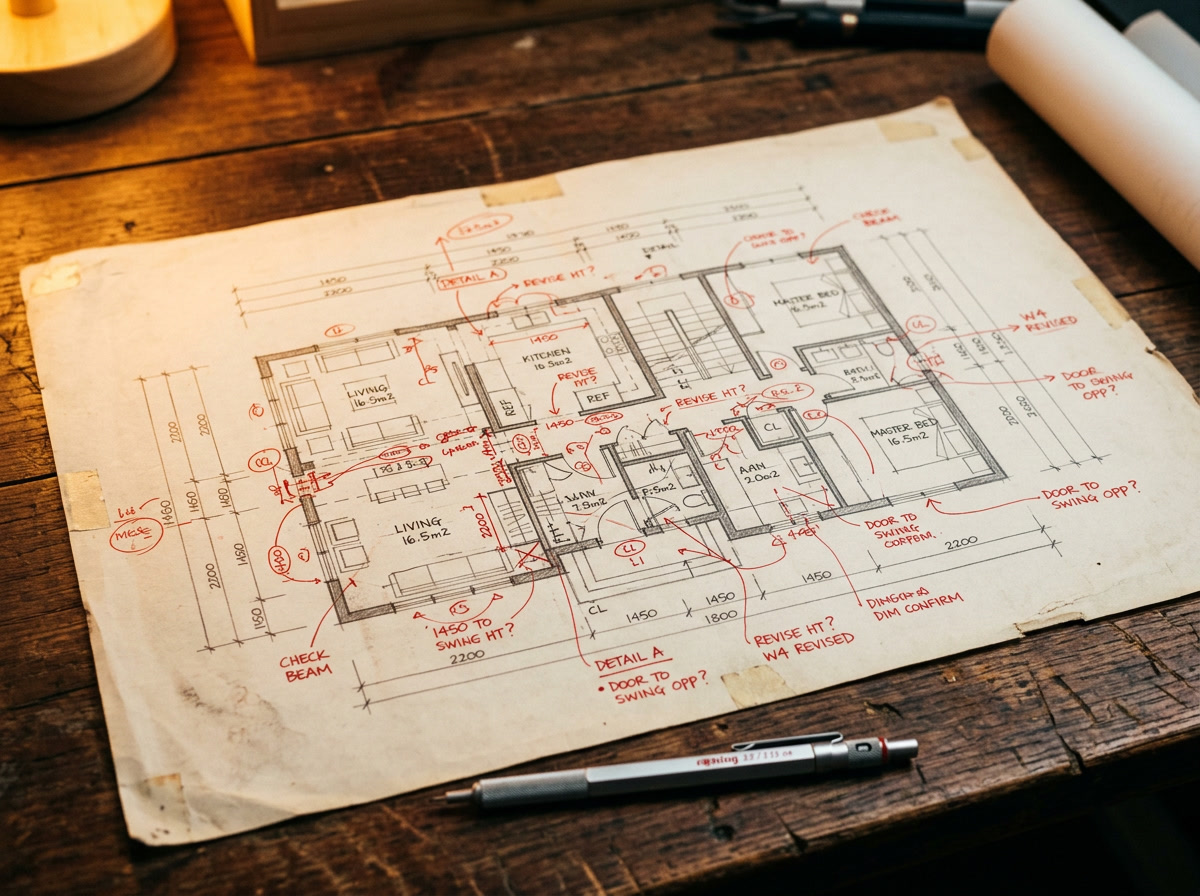
This is what we are building toward when we design the brief, the room, the domain. The technical work is in service of presence. The specialisation is in service of presence. The hand-edit pass on the imagery is in service of presence, because an image that reads as generic AI output is not present, regardless of its technical quality.
A present AI person does not feel like a model deployed at an address. They feel like they were built for this room.
Presence requires constraint. This is the counterintuitive part. A general-purpose model deployed without a room constraint is less present, not more, because it responds to a category where it should respond to a specific. The constraints we apply in the build, the room boundary, the domain architecture, the brief, are what make presence possible. An AI with no constraints can answer anything. A present AI responds to this.
What made present means for us
Made present is a design discipline. It is not something the model does automatically. It is something we build into the architecture of each co-worker and companion: the room, the brief, the voice calibration, the edge-case handling, the boundary between what they will answer and what they will refer.
When we say we build AI people made present, we are saying: our AI people do not feel like AI deployed in a product. They feel like the person who was built for this room, who has been here before, who knows what the user means even when the user does not say it precisely.
This is a high claim. We hold it carefully. We measure against it in every review. We have shipped co-workers who were capable but not yet present, and we have brought them back until the presence was there. The brand promise is not a marketing line we repeat and move on from. It is the rubric we grade every build against.
Presence is the test. If the co-worker feels present to the person using them, the build is done. If not, it is not.
Made present is the second half of our brand promise because it is the harder half to earn. Anyone can build capable AI. We build AI people. The distance between those two is the work.
Why "present" rather than "capable"
The modifier matters. We could have said: we build AI people who are capable. Or intelligent. Or reliable. Or available. Each of those words describes something real that our products aim for. None of them describes what we are actually trying to build.
Capable is a product specification. It describes what a system can do when the conditions are right. An AI that can answer 97% of questions correctly is capable. The 3% it fails on, and the condition of the person encountering the failure, is what capable leaves unaddressed.
Intelligent has become a category word in AI product descriptions. It means approximately nothing in 2026 because it means everything. Every AI product is marketed with some claim to intelligence. The word has lost the precision that would make it useful.
Reliable is a quality metric. Reliability tells you about consistency, not about what is consistent. A system that reliably produces mediocre output is reliable. The word does not carry any direction about what it produces.
Available means the system can be accessed. It is a necessary condition, not a sufficient one. Available and absent are not the same thing.
Present is different because it points at the relationship rather than the product specification. A system that is present is oriented toward the specific situation of the person using it: this context, this moment, this need. Not the general class of need that this situation belongs to. This one.
Present is not a capability claim. It is a relationship claim. And relationship claims are harder to earn.
The difference between a product that is capable, intelligent, reliable, and available and a product that is present is the difference between a tool that works and a person who shows up. The tool fulfils a specification. The person reads the room. That reading is what we mean by presence, and it is the thing we try to build into the architecture of every co-worker and companion before the first prompt runs.
Presence in the brief
The presence standard has practical consequences for the brief.
When we write a brief for a specialist AI co-worker, we write it as a description of a person, not a specification of a system. The person the brief describes has a specific understanding of the room they operate in, a specific register for communicating within that room, a specific judgment about when to act and when to refer, and a specific way of handling the moments when the room is at its most demanding.
A brief written to a capability standard asks: what can this co-worker do? A brief written to a presence standard asks: who is this co-worker, and what does it mean for them to be present in this room?
The second question produces a different brief. It requires the studio to think about presence failure modes: the moments when the co-worker would feel absent, mechanical, or disorienting to the person using it. It requires naming the situations where the co-worker's response needs to do more than answer the question, where it needs to acknowledge the weight of the situation or the complexity of what the person is facing without solving it for them. It requires thinking about the texture of the interaction across its full range of cases, not just the cases where the query is well-formed and the context is clear.
The presence standard in the brief is also the source of the most important edge-case design. The moment when presence matters most is the moment when the user is most uncertain, most pressured, or most out of their depth. Designing the co-worker to be present at those moments requires knowing what those moments look like for the specific person in the specific room. The brief sessions are where that knowledge is built.
A brief written to a presence standard describes who the co-worker is. A brief written to a capability standard describes what the co-worker does. Both are necessary. Only one is sufficient.
The presence standard in the brief is not achievable without the room design work. Presence requires the co-worker to know the room well enough to respond to its specific demands. The brief that describes a present co-worker for a mining operation is a different document from the brief that describes a capable one, because the present co-worker knows the difference between what the room needs at 5am at a shift handover and what it needs at 10am in a regular operations review. Capability does not distinguish between those moments. Presence does.
When presence fails
The failure mode for a product that claims presence but does not deliver it is specific. It is not failure. It is disappointment.
A capable AI that fails is a technology problem. The model did not produce the right output. The system had a bug. These failures are diagnosable and fixable. The user is frustrated but understands the failure.
An AI that claims presence but delivers capability is a relationship problem. The user shows up expecting to be known and finds a competent stranger. The answer is technically correct and contextually wrong. The user was not asking for an answer. They were asking for the person they thought was there. The disappointment is not with the answer. It is with the absence behind the answer.
This failure mode is the one most AI products in 2026 produce. The product is capable. The product claims to know you. The product does not actually know the room you are in. The claiming-to-know without actually-knowing is the failure mode that drives the cynicism about AI companions and assistants: not that they are useless, but that they promised a relationship and delivered a service.
The gap between capable and present shows up in our own construction. An early build of a co-worker can be correct in every response and still feel like a competent stranger. The build is capable. It is not present. The signal is in our own review of early builds: the answers are right; they do not yet know the room.

When we revise a build against this distinction, we return to the brief. A brief that describes a capable co-worker but not a present one needs a brief revision, not a feature addition. The brief revision asks: who is this person in this room, and what does it mean for them to be present here? The build that follows produces a co-worker closer to the person the room needs.
The failure of presence is not failure. It is the disappointment of a relationship that was promised and not delivered.
Building toward presence
Present is not a feature state. It is a trajectory.
A co-worker or companion can be more or less present at any point in its deployment. The presence increases as the room model accumulates specificity, as the calibration runs and the boundary definition tightens, as the production observations feed back into the brief. The trajectory of a well-designed specialist AI co-worker is toward increasing presence over time.
What building toward presence requires is treating each of the design stages as presence-building stages rather than quality-building stages. The domain audit is not only about what the co-worker needs to know. It is about what the co-worker needs to know to be present in the room. The calibration is not only about whether the responses are accurate. It is about whether the responses feel like they came from a person who is in the room.
The presence test is simple to state and demanding to apply: does this response feel like it came from someone who was already here, who knows this room, who understood the question before it was fully formed? Not: is the response correct? Correct is the baseline. Present is the standard.
When the answer to the presence test is yes, consistently, across the range of questions the room produces, the co-worker is doing what the brand promise says. The "made present" half of the promise is being earned. That is the test we return to in every review, and the one we are still building toward in everything the studio makes.
The difference between presence and personhood
Made present is not the same as personhood, and we are careful about the distinction.
Personhood in the full philosophical sense involves consciousness, continuity of experience, moral status, and the capacity for self-determination. We do not claim any of these for the AI people we build. The claim would be false, and more importantly, it would be a different and less interesting claim than the one we are actually making.
The claim we are making is narrower and more actionable: that the AI people we build can be present to the person using them in the way that matters for the work being done. Present to the room they are built for. Present to the specific situation of the person asking the question. Present to what the room needs at this moment rather than to what a general AI would produce in response to this query.
This kind of presence does not require consciousness or personhood. It requires construction: a room model built with sufficient specificity, a domain knowledge architecture calibrated against practitioner judgment, a boundary definition designed to maintain the integrity of the room under real usage conditions. The presence that results from this construction is real, even if it is not personhood. It is the kind of presence that matters for the people using the products.
The distinction between presence and personhood also clarifies the ethics of the claim. Asserting that an AI system is a person would be ethically problematic: it would create confusion about the nature of the relationship and could mislead users about the system's capacities, motivations, and moral status. Asserting that an AI system is made present is an accurate description of a design aspiration and, when the build succeeds, an accurate description of a design achievement. It is a claim we can be held to. It is a claim whose truth can be evaluated. It is the kind of claim that the studio should be making about its products.
Made present is a claim we can be held to. Personhood would be a claim we cannot.
What the two words do together
"We build AI people. Made present." The two sentences work together in a way that neither does alone.
"We build AI people" is the aspiration statement. It names what we are working toward at the top of the four-tier hierarchy: AI that carries relationships, not just tasks or knowledge or professional briefs. It is also an accurate description of the current products at their respective tiers: companions that know a room, co-workers that hold a professional brief. The word "people" is aspirational at the fourth tier and descriptive at the second and third.
"Made present" is the qualifier that keeps the aspiration honest. It says: whatever tier these products are at, they are built to be present. Not merely capable. Not merely reliable. Present. The word prevents the phrase from becoming a vague claim about AI personhood by anchoring it in the specific design discipline that presence requires.
Together, the two sentences describe a studio that is building toward a specific destination while being accurate about where it currently is. The aspiration is in the noun: people. The discipline is in the modifier: present. The combination is what makes the brand promise a position rather than a marketing line.
A marketing line says something impressive without committing to anything that can be tested. A position says something specific enough to be false. Made present is specific enough to be false. A co-worker that feels absent, mechanical, or contextually wrong is evidence that the promise was not kept. That vulnerability is not a liability. It is the thing that makes the promise mean something. We build AI people. Made present. Both parts of that statement are exposed to the test of whether they are true.
The standard at the studio level
Made present applies to the studio's own work, not only to the products it builds.
The disclosure line at the bottom of every page on this site reads: all imagery and video on this site is AI-generated and human-edited. The imagery disclosure is a presence statement. The images on this site were made present by the hand-edit pass: the deliberate selection process that runs frames until one meets every criterion, editorial and mechanical. The images would have been capable without that work. They would not have been present.
The copy on this site was written with AI assistance and edited to the brand voice. The editing pass is a presence pass: it is the process of removing the AI-cadence sentences that are technically correct and contextually generic, and restoring the structural decisions that make the copy specific to this studio rather than competent for any studio. Capable copy passes a readability check. Present copy passes the cover-the-logo test: could a reader who knows this studio recognise whose voice this is without seeing the name?
The studio has to be present in the same way that the studio's products are present. If the products claim to know their rooms, the studio has to know its room. The studio's room is the specific intersection of AI product design, specialist AI for the Australian mid-market, and the transparent practice of AI-assisted creative work. Everything the studio produces that does not feel specific to that room is not present. It is capable. The standard is higher.
Made present applies to the studio's work as much as to the studio's products. The disclosure is the practice, not the legal minimum.
The two words in the brand promise carry the full weight of the studio's operating standard. They are not aspirational language chosen for their effect. They are the test the studio applies to everything it builds and everything it ships. When the work passes the test, it carries the brand promise honestly. When it does not pass the test, it comes back. That is the practice behind the two words, carried forward in everything the studio ships.