Six checks per frame. The AI image hand-edit pass.
Every Graaft image runs six checks before it ships: anatomy, text, light, material, narrative, delivery. What the hand-edit pass looks like in practice.

Frame thirty-one failed. The moment was architecturally correct: light came from the right direction, the proportions held, the material read as stone rather than as the idea of stone. But the moment had never happened. A window at that angle, in that building, at that hour, with light falling that way. The frame was convincing. It was not true. I rejected it.
Frame thirty-four shipped. It had been through the full pass: six checks, in a fixed order, because the order is what makes the pass work.
Every image on this site went through it. Every image in every Graaft deliverable goes through it.
The six checks, in order
One. Anatomy and count. Hands, fingers, limbs, teeth, eyes, ears. The failures everyone knows about, and still the most common reason a frame dies. What the check actually involves is counting. Fingers on every visible hand, out loud if the frame is busy. Then the joints, because a five-fingered hand with a thumb bending the wrong way fails just as hard as a sixth finger. Then teeth, which arrive in the wrong number more often than people expect and cannot be unseen once noticed. Then the eyes, confirming both are looking at the same thing. Fast to run, fatal when it fails, and the reason it goes first: there is no point spending editorial attention on a frame with six fingers in it.
Two. Text and marks. Signage, screens, book spines, packaging, keyboards, mugs. Generated lettering is almost always wrong, and invented logos are worse than wrong, because an invented logo drops a fictional company into a frame that is claiming to show a real working environment. If a surface would carry text in the real world, it gets read letter by letter. Book spines behind a subject are the most common failure: small, numerous, and easy to skip past. Keyboard legends are the second. Where the text cannot be repaired, the answer is usually a reframe or a shallower depth of field rather than a fix.
Three. Light and physics. One source or two, and do the shadows agree with them. Reflections that match what sits in front of the surface, particularly on glass, screens and polished wood. Scale that holds between the near object and the far one. Contact shadows where objects meet surfaces, because a mug floating a millimetre above a desk reads as wrong before anyone can say why. Frame thirty-one passed this check cleanly, which is exactly the point of running the three that follow it.
Four. Material truth. Does the stone read as stone, or as the concept of stone. This one changes with scale: a material can be correct at thumbnail size and become an approximation of itself at full resolution, where the surface turns into a texture no physical process would produce. Fabric shows it first, then wood grain, then skin. The check runs at full resolution, always. Running it at review size is how a material failure reaches production.
Five. Narrative truth. Could this moment have occurred. Not whether it looks plausible: whether the combination of objects, light, posture and place could exist together, and whether the person in the frame would be doing that thing in that room at that hour. This is where frame thirty-one died. It costs the most attention of any check, because a frame that reaches it has already earned some trust, and trust is what makes a false moment hard to see.
Six. Delivery. Export at delivery settings. Open it at the size and the crop the audience will actually see, on the surface they will see it on. A frame reviewed at full width on a colour-managed display and shipped into a small card on a phone are two different images. This check cannot be run in the review environment, which is exactly why it is the one most often skipped. Felix makes the same argument about identity work in 32 pixels, on a receipt.
The most seductive failure is the one that passes every mechanical check. The editorial checks are what find it.
Why the order is fixed
The order is not preference. Different failures become visible at different depths of attention, and attention is a depleting resource.
Checks one to three are mechanical. They are fast, and a careful eye running them specifically rather than generally will clear a frame in under a minute. Checks four and five are editorial. They are slow, they cannot be run in isolation from the brief, and they are the ones abbreviated first under time pressure. Check six cannot be run at all in review conditions.
Putting the mechanical checks first means the expensive attention is only ever spent on frames that have earned it. Putting the seductive failures last means they meet an eye that has not already been spent counting fingers.
There is a second reason the order holds. Running the checks in a fixed sequence makes the pass repeatable by someone other than the person who designed it. A pass that depends on the reviewer's mood or on what they happen to notice first is not a discipline. It is a preference with a process diagram attached.
One batch, start to finish
The batch that produced frame thirty-four ran to just over forty frames. The attrition has a shape, and it is close to the shape most batches have.
The largest group died at check one, and they died in seconds. Hands, mostly. A frame with a malformed hand does not get a second look, and it does not get a note explaining why, because there is nothing to learn from it that the next batch will use.
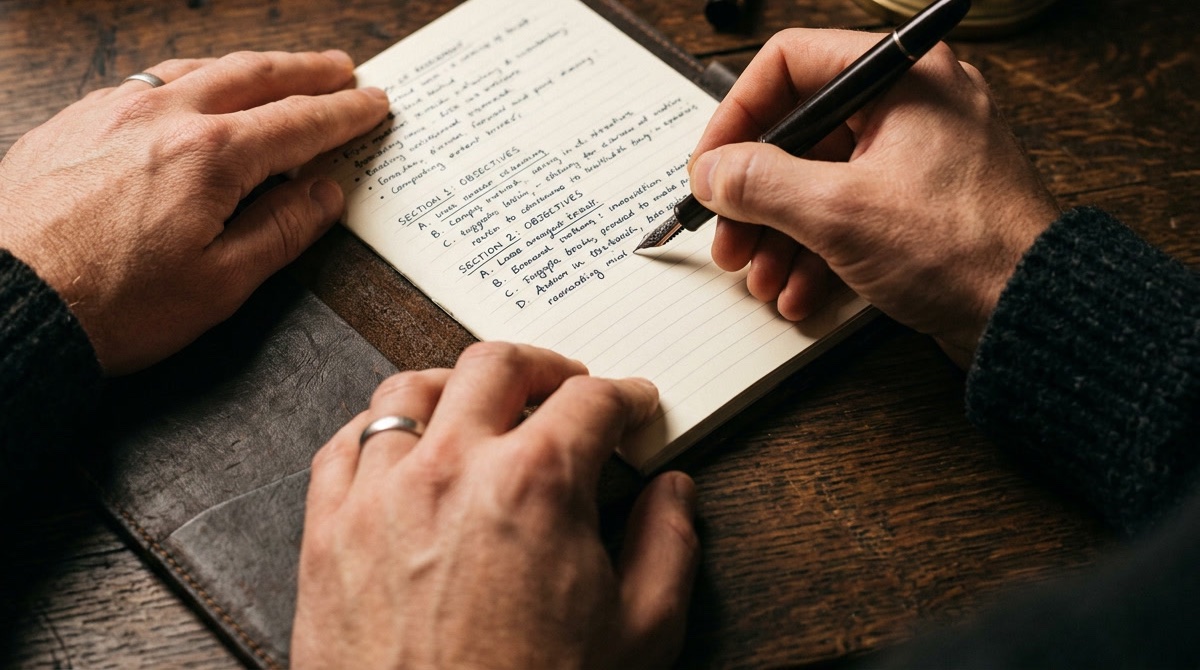
The survivors thinned fastest across checks two and three. Text failures are the frustrating ones, because they often sit in an otherwise strong frame and the strength makes you want to argue for it. A frame with a beautifully lit desk and three unreadable book spines behind it is still a rejection. The argument for keeping it is always the same argument, and it is always the one to distrust.
Checks four and five killed fewer frames and cost far more time per frame. This is the part of the pass that feels least like quality control and most like editing. You are no longer asking whether the frame is broken. You are asking what it is claiming, and whether the claim is true.
Check six sent one frame back rather than killing it. That is typical. Delivery failures are usually crop and scale problems rather than image problems, and the fix is a re-export rather than a regeneration.
Frame thirty-four was not the best-looking frame in the batch. Two others were more striking at review size. Both failed check five. The frame that ships is the frame that clears all six, which is not the same thing as the frame you liked most on the first pass, and learning to tell those apart is most of the skill.
Where the checks came from
They were not derived from a theory of image quality. They were built out of failures.
Each one has an origin: a deliverable that shipped with a flaw invisible in the review environment and obvious in production. A frame that passed three reviews and then fell apart at hero size on a staging display. A material that read correctly at thumbnail scale and as an approximation of itself at full resolution. A moment that was technically correct and narratively false.
Six is where the list settled. Below six, something gets through. Above six, every additional category turns out to be a subset of one already on the list.
The editorial checks cannot run without the brief
Checks four and five need to know what the image is for, who will see it, and what claim it is supporting. Without that, they have nothing to calibrate against.
This is why briefing matters at the imagery layer and not only at the copy layer. A brief that specifies the emotional register, the context the image appears in, and the claim it supports makes the editorial checks faster and their verdict more reliable. A brief that says we need a hero image for the co-workers page makes them slower and less certain, because the register and the narrative are underspecified. It is the same argument we make about drawing the boundary before the output in hallucination is room design.
When check four or five starts taking noticeably longer than usual, that is not a difficult frame. That is an underspecified brief. A briefing conversation at that point is faster than generating against a brief that cannot support a verdict.
The rejection ratio
The ratio of frames generated to frames shipped is high, and that is a choice about editorial investment rather than a consequence of cost.
You could generate three frames and ship the best one. The best of three beats the best of one. It is rarely as good as the best of a much larger set, because quality is spread widely across a batch and the frames that clear all six checks are not evenly distributed. Some batches produce nothing in the first ten. Some produce two in the first five.
The marginal cost of one more frame is close to zero. The review is where the time goes. That relationship is unusual, and it means the ratio, not the generative brief, is the primary editorial decision in AI imagery work.
It also means the constraint on quality is reviewer attention rather than generation budget. A studio that doubles its generation volume without adding review capacity has not raised its ceiling. It has lowered its standard, because the same eye is now clearing twice as many frames in the same hours, and the checks that suffer are four and five: the slow ones, the ones nobody notices you skipped.
The discipline is not a particular number. It is that you have a reason for the number you choose, and that the reason is a claim about the quality you are willing to ship rather than a claim about how much time you had.
The reject-to-ship ratio is the primary editorial decision in AI imagery work. It is a claim about quality, not about how long you had.
What survives all six
Some failures pass every check and are still wrong, because the pass runs on one frame at a time and these failures only exist across a set.
The first is sameness. A model asked repeatedly for the same register converges. The same face reappears with a different haircut. The same window light falls at the same angle across four frames that were meant to show four different rooms. Each frame passes all six checks on its own. Laid side by side they read as one place photographed repeatedly, which undoes the thing the set was commissioned to do.
The second is register drift. Over a long batch the frames move: slightly warmer, slightly more staged, slightly more like stock photography. No single frame crosses the line. The set arrives somewhere the brief did not ask for.
The third is the frame that is correct and says nothing. It passes anatomy, text, light, material, narrative and delivery, and it carries no argument. It is a photograph of a desk. Nothing about it is wrong and nothing about it is worth publishing.
So there is a step after the six, and it is not a check. It is laying the shipped set out together and asking what it adds up to. That step catches what per-frame review cannot, and it is the one most likely to be skipped, because by then every frame in front of you has already passed.
The checks are moving
The six are stable. The time each one costs is not.
Anatomy is getting cheaper every model generation. The hand problem that defined the category is largely solved, and check one now clears frames that would have died two years ago. Text is improving and is not solved: lettering is better, invented logos are not, and the check still earns its place.
Narrative truth is going the other way. As frames get more convincing, the false moment gets harder to see, because the signals that used to give it away have been fixed. Frame thirty-one failed check five precisely because it passed everything before it. The better generation gets, the more of the pass's cost moves into the two checks that cannot be automated.
The pass does not get shorter as the models improve. It rebalances. Less time counting fingers, more time asking whether the moment could have happened. That is the direction, and it is worth planning for, because the checks getting cheaper are the ones a tool could eventually run, and the checks getting more expensive are the ones that need a person with the brief in their head.
What human-edited claims
All imagery and video on this site is AI-generated and human-edited. That line is doing specific work.
It means every check, in order, on every frame, before it ships. It means many frames generated for each one that survives. It means finding the frame that failed check five and rejecting it even though almost nobody would have caught the failure.
The frame that clears all six is not perfect. It is good enough to publish under that disclosure. That is the bar. Not photographic truth. Not the impossibility of identifying AI origin. The bar is that the image went through a named editorial discipline run by the person whose name is on the work, and the disclosure points at that discipline. A disclosure backed by a real standard is a different kind of claim from a disclosure backed by nothing.
The written equivalent runs on the same principle: the six tells I cut from every AI draft, and the studio's position on working this way is set out in we build AI people, of course we use AI.
Where the pass does not reach
The six checks are calibrated for editorial imagery in a marketing context: the working world, the studio's visual language, the scenes that go with knowledge work and AI collaboration. For that, they are enough.
They are not enough everywhere. Images of real people need ethical and legal review the checks do not cover. Images in regulated contexts, medical or financial or legal, need domain accuracy work beyond anything on this list. Images depicting real events or real places need a narrative-truth review far heavier than check five.
The claim the pass makes is narrow, and it is the only one worth making. Not that AI imagery matches photography. Not that our images are photorealistic. Only this: every image here was reviewed against six named checks by the person responsible for it, and the ones that failed were rejected.
The speed of generation is a resource, not permission to lower what ships. Generate many. Reject most. Ship the frame that cleared all six, under a line that says exactly what happened.